Many people feel confused about yay or nay. These two small words are easy to say, but they are used in very different situations.
This article will give a simple explanation of yay and nay, so students, learners and beginners can understand them بسهولة (easily).
You will learn the difference between yay and nay, their meanings, and how to use them correctly in real life.
Why People Get Confused
Both words are short and sound similar:
- Yay sounds happy
- Nay sounds serious
But they have opposite meanings:
- Yay = positive feeling
- Nay = negative answer
Because they are often heard in speech, many learners mix them up.
Quick Answer: Simple Difference
- Yay → shows happiness, excitement, or approval
- Example: Yay! We won the match!
- Example: Yay! We won the match!
- Nay → means no, refusal, or disagreement
- Example: I vote nay on this idea.
- Example: I vote nay on this idea.
Easy Trick to Remember
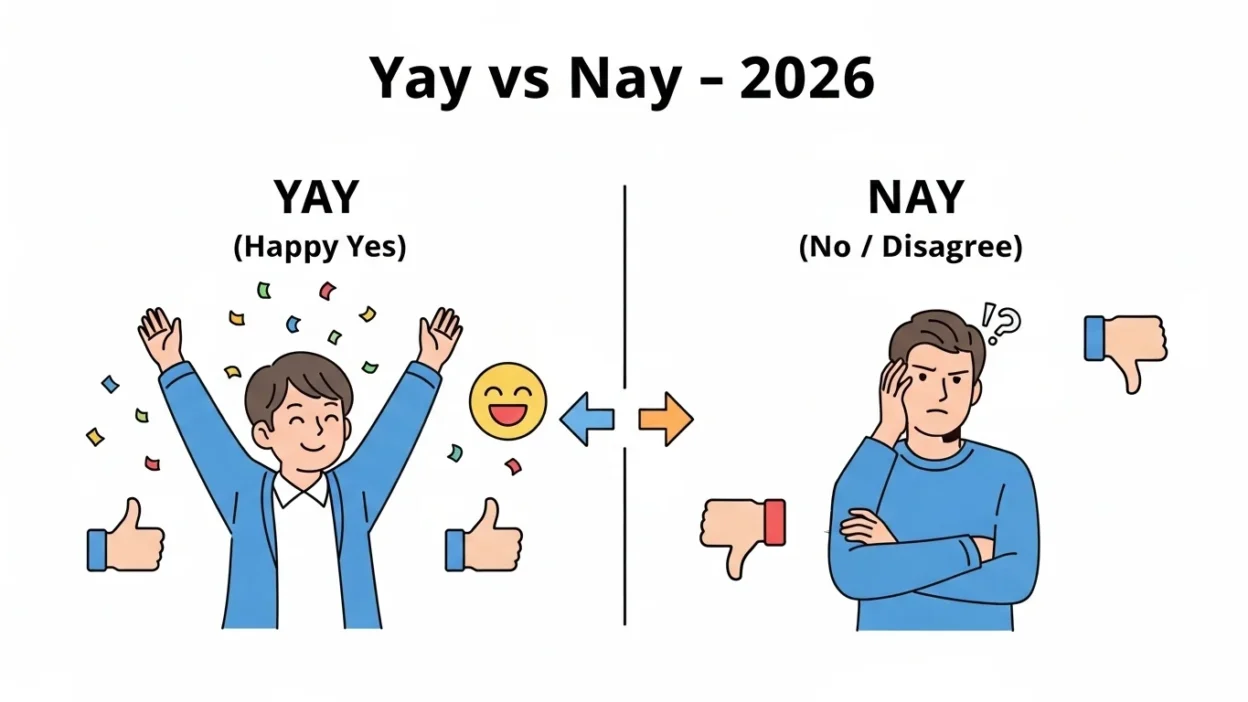
- Yay = happy yes feeling
- Nay = simple no answer
Origin and Background
- Yay comes from expressions of joy and celebration.
- Nay comes from old English and was used in formal voting to mean “no.”
Today’s Usage
- Yay → very common in daily life and social media
- Nay → mostly used in formal situations or old-style speech
Clear Explanation of the Difference
| Word | Meaning | Tone | Example |
| Yay | Happiness or excitement | Informal | Yay! I passed the exam! |
| Nay | No or disagreement | Formal | The group said nay to the plan |
✔ Yay = emotion (feeling)
✔ Nay = decision (no)
When to Use Yay or Nay
Use Yay When:
- You feel happy or excited
- You are celebrating something
Examples:
- Yay! It’s my birthday!
- Yay! No homework today!
- Yay! We finished early!
Use Nay When:
- You want to say no
- You disagree
- You are voting or making a decision
Examples:
- I vote nay on this idea.
- She said nay to the offer.
- The team chose nay after discussion.
When NOT to Use Yay or Nay
This is very important for beginners.
❌ Do NOT use “Yay”:
- In formal writing
- In serious situations
Wrong: Yay, your application is rejected.
Correct: Your application is rejected.
❌ Do NOT use “Nay”:
- In normal daily conversation
Wrong: Nay, I don’t want tea.
Correct: No, I don’t want tea.
✔ Use “no” instead of “nay” in everyday speech.
Yay vs Yes | Nay vs No
This helps many learners understand better:
- Yay vs Yes
- Yay → emotional (Yay! I’m happy!)
- Yes → normal answer (Yes, I agree)
- Yay → emotional (Yay! I’m happy!)
- Nay vs No
- Nay → formal or voting
- No → everyday speech
- Nay → formal or voting
Everyday Real Life Examples
Social Media
- “Yay! Weekend is here!”
- “Yay! New phone arrived!”
Friends & School
- “Yay! Holiday tomorrow!”
- “I say nay to extra homework.”
Group Decisions
- “All in favor say yay.”
- “All against say nay.”
Simple Situation Example
Friends choosing a movie:
- “Comedy movie?” → Yay!
- “Horror movie?” → Nay!
Mini Practice: Fill in the Blank
- ______! I passed my test!
- I vote ______ on this plan.
- ______! We are going on a trip!
- She said ______ to the idea.
✅ Answers: Yay, Nay, Yay, Nay
Extra Practice: Real Life Choices
Choose the correct word:
- Your team wins a match → ______
- You disagree in a meeting → ______
- You are excited about a trip → ______
- You reject an idea → ______
✅ Answers: Yay, Nay, Yay, Nay
Learning Tips for Students and Beginners
✔ Quick Rule:
- Yay = happy feeling
- Nay = no / rejection
✔ Think in situations:
- Party → Yay
- Decision → Nay
✔ Practice daily:
- “Yay! I finished my work.”
- “I say nay to junk food.”
FAQ Section
1. What is yay meaning?
It means happiness, excitement, or celebration.
2. What is nay meaning?
It means no or disagreement.
3. What is the difference between yay and nay?
Yay shows happiness, while nay shows refusal.
4. Is yay formal or informal?
Yay is informal and used in casual situations.
5. Is nay used in daily conversation?
No, people usually say “no” instead.
6. When should I use yay or nay?
Use yay for excitement and nay for decisions or voting.
7. Are yay and nay opposites?
Yes, they often show positive vs negative responses.
8. How can beginners learn yay vs nay easily?
Use simple practice and remember:
- Yay = happy
- Nay = no
Quick Summary (Easy to Remember)
✔ Yay = happiness, excitement
✔ Nay = no, disagreement
✔ Yay → informal, fun
✔ Nay → formal, serious
Conclusion
Now you clearly understand yay or nay and the difference between yay and nay.
- Use yay when you feel happy or excited
- Use nay when you want to say no in formal situations
For daily life, remember:
👉 Yay = happy yes feeling
👉 Nay = formal no
Practice with real life examples, and you will never confuse them again.

Andrew Christopher is a passionate visionary who blends creativity with purpose to bring ideas to life. With a focus on innovation and integrity, he inspires growth and lasting impact.